Showing posts with label sunset. Show all posts

Sunday, 27 May 2012

Ao Nang www.wanderingwendyswonderings.blogspot.com


Both beautiful and bland all in one yawny breath.  As long as you face west, this place is as stunning as any other of the exquisite beaches of Thailand that line its coasts.  On bright days the sea is calm and a colour chart of warm green to deep blue, lime stone islands are dotted across the horizon and long tail boats bounce along the surface of the ocean, spraying a white tail behind them.  Turn around though and you have a watered down version of Khao San Road, catering for families, men looking for Thai love longer than one night, and package holiday makers.  

A road runs along the side of the beach, elevated from the shore.  On the other side of the road from the beach are restaurants, at present desperate for custom, each one along a baht less for a pizza, or an extra percent off the menu, what with it being the beginning of low season.  There are countless souvenir shops, 7-11’s, massage parlours, hair braiding, travel agents and T-shirt shops, blah, blah, blah.  The depravity of Khao San Road is not here, but its essence is.  The wrist bands with obnoxious messages have gone, but the t-shirts aren’t much better.  Most extolling the virtues of women with their legs spread.  

(Ahhh, yawn, I am almost too bored to write any more about the place.  Did I mention it was bland?)  

The road curves up away from the beach, to be over looked by an imposing limestone monolith, making the banality of the activity below all the more apparent.  Further up the road are more of the same, Irish bars, Reggae bars, Girly bars and more massage.  

However, to be fair to the place, although it is bland, in the blandest sense of the word, it is very clean – not that that should be the selling point of a place.  Oh, it’s clean.  A hospital is clean, but who wants to holiday in a hospital.  And there is a lot of green.  Again, not exactly a selling point given that crocodiles are green, and, again, no one wants to holiday in a crocodile.   Trees have been planted every couple of metres along the road.   Tiles have been inlaid into the pavements to make them look more interesting, in a bland kind of way.  There are curved benches, and snaking low walls that all show a bit of thought in the design of the place.    

Oh my life, I can’t be bothered to talk about the place any more….it’s too…..bland?  Oh, but there are the sunsets......


Copyright notice

The content on this website is copyright of Wendy King - © Wendy King 2012 All rights reserved.
www.wanderingwendyswonderings.blogspot.com
Any redistribution or reproduction of part or all of the contents in any form is prohibited other than the following:
·         you may print or download to a local hard disk extracts for your personal and non-commercial use only
·         you may copy the content to individual third parties for their personal use, but only if you acknowledge the website as the source of the material
You may not, except with my express written permission, distribute or commercially exploit the content. Nor may you transmit it or store it in any other website or other form of electronic retrieval system.

Thursday, 8 March 2012

Kanyakumari


Where the Indian Ocean meets the Bay of Bengal and the Arabian Sea.  Where yellow sand meets black and red sand.  Where the Indian pilgrims flock, Kanyakamari, the Southern-most tip of India, to watch the sun rise and set over the sea and bathe in the sacred waters.  And no, I have no idea why they are sacred.  And no, I have not bathed in them.  

Kanykamari is much more of what I expected from India.  Touts, beggars, excited children, pilgrims and persistent necklace sellers.  Selling real pearls, of course, a whole string of them, perfectly formed and beautifully iridescent all for a 100 rupees.  They’ll even try and burn them with a lighter to prove to you that they are not plastic, as someone cynical may suspect them to be.  The main bazaar that leads up to the temple, which is positioned right on the tip of India, is lined with ‘fancy’ shops and trashy souvenirs.  Lampshades, mirrors, necklaces, hanging decorations all made from shells are abundant, and are as kitsch as the 1970’s.  Plastic rickshaws, machine guns, boats and dolls can all be bought for 30 rupees.  People throng up and down the busy little street at night and mooch lazily along it during the day, in the beginning of this very hot Indian summer.  There is a good breeze that skips in from the many seas, which makes walking around this disparate little town just tolerable.  There are fishing boats that line the edges of the seas, and brittle reed houses set a little further back that sit in the cool shadow of large expensive hotels.  On the dusty streets, amongst the tat shops, imposing hotels, and grimy lodges, are snippets of the past. 
  Dilapidated temple entrances sneak in between shops, their perverse statues of horse/lion/drangon/elephant hybrids, with huge penises that are fucking small elephants, which in turn are fucking even smaller, surprisingly happy little men at the bottom, sit ignored, whispering tales of times gone by to the covered, conservative, now censored Hindus that wander past wishing to prostrate themselves to the sun.  

Sunrise and sunset are the things to do here.  Although, there is also the candy pink Gandhi memorial which held his ashes before they were immersed, and where I was asked to make extra donations to the pocket of the woman who looked after my shoes.  I pointed out that this was the Gandhi memorial, and opportunistic scrounging was maybe a little incongruous, but I think the subtlety of the point was lost on her, she just scowled and spat when she realised I wasn’t going to ‘donate’ to her.      


I got up at 5.20 am to secure myself a good spot for the sunrise, as did a few thousand other people.  It was far more bustling than I have ever experienced 5.20 am to be before.  Calls of ‘chai, chai, chai’, ‘coffee, coffee, coffee’ punctuated the din of the crowds, the bell of a boy selling bags of pink candy floss tinkled in endless circuits around people, and the relentless whispering on the necklace sellers trying to prove the authenticity of their pearls could be heard with every step.  I made my way down to the Ghats, and managed to find a good spot on a wall, which was clearly the envy of many others, whose closeness and gentle nudging made me suspect they were wishing to make space for themselves, by ousting me.  People swarmed down to the Ghats, into the sea and onto the rocks, and stared excitedly at the large Vivekananda statue that sits benignly on a rock just off shore.  As the skies lightened and the sun struggled its way into the day behind the hazy of cloud, there was a cheer and applause from the gathered crowd.  And eventually, the sun wrestled free from the haze, and presented himself as a large, proud red disc to his followers beyond Vivekananda.   (Vivekananda is the wandering monk who dedicated his life to bringing a sense of social justice to Hinduism.)

Sunset was a little more manageable time wise.  I wandered back down to the same spot I watched sunrise from, but looking in the other direction.  The place was a mass of people who seemed more akin to holiday makers as opposed to pilgrims.  There were fried food sellers lining the edges of the Ghats, offering samosas, battered chilli’s, fried bananas, tough orange coloured sweetcorn (even the beggar children turned that down when I offered it to them) and fruit.  Along the front of those, white horses trotted gleeful children up and down, and on the beach families, giggling girls and boisterous boys teased each other with the sea.   The men swimming with happy exhuberence and the women gently testing the water, laughing at the waves that splashed them while they egged each other on to step in a little deeper.   Laughter and sounds of people enjoying themselves mingled with the horn-like voices of the chai sellers.  There was the occasional genuine pilgrim, spotted as if in a game of where’s wally, identifiable by their orange robes, who entered the sea with their plastic Pepsico bottle to fill it with sacred sea water.
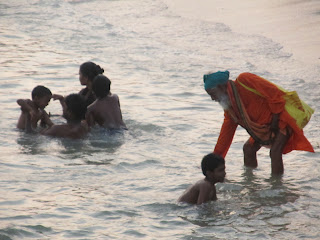
 
I like Kanyakumari.  This is what I had in my expectations of India.  People, noise, bustle.  And the strange thing is, that even though I have come here as a lone female traveller, I have not been hassled or felt under so much scrutiny as I have done in the Western tourist destinations.  Here I am seen as more exotic and a little more unapproachable than a trophy fuck……………And before I even had time to finish that sentence, and Indian man strikes up conversation with me.  After a couple of minutes inane conversation, about his future wife and family, he asks what room number I am and tells me we should go there, to enjoy, presumably.  

I honestly don’t know how women deal with travelling around this country alone.  I don’t want to assume that every man who talks to me is wanting to ‘enjoy’ me, and who then assumes I will thanks to the portrayal of Western women in movies.  I imagine most porn actresses are white.  In a culture where the men and women are separate and have little interaction within groups after childhood, and the women are taught when young to be hostile to men, that a smiling face with a willingness to talk must seem easy, accommodating; available.  It makes the idea of travelling on my own seem a little daunting.  I would have to adopt a hardness I wouldn’t want to just to deal with people.  To have to be incredibly wary of those around me, to not talk to any local, to be hard towards people.  I don’t  want to do that.  I am not sure there is any country where I want to be like that.  

Someone said to me yesterday, ‘As soon as you think you have things figured out here, something will come along to completely contradict what you thought you knew.’ 

Sunday, 13 November 2011

Hampi


This place is almost unbelievable.  The boldness of its beauty is just breathtaking.  The heart feels overwhelmed.  Hampi , as it is now, is just a small village, there is a bazaar with narrow streets that feel cluttered and erratic, lined with cows and small shops selling jewellery, clothes and general commodities, a few guest houses and very little happening, but there is a sense of serenity here, and calmness that rests on the soul upon arrival.The place feels quite surreal, and I finally feel I am getting closer to the Indian experience.  From the motorised buzzing of the yellow and black rickshaws that chase the tourists around, to the magic baba’s with painted faces and orange robes, plucking golden trinkets from thin air, coughing up huge stones and the village elephant decorated with colourful painted patterns.  All the senses are tantalised.  There are the sounds of a procession, trumpets, flutes and drums as they meander around the village announcing the marriage of a young couple, the music lasting three days (there have also been the sounds of their arguments when the alcohol has got too much and the women and men screech ‘you bitch’ at each other in their local language from the roof tops).  There are smells of sandalwood and jasmine as thick whorls of joss stick smoke twist from the houses and restaurants into the street.  The feel of children as they run up to touch the skin of a strange white giant.  The taste of real Indian cooking, not food adjusted for the sensitivities of the westerner, but spices that set the lips tingling like hot coals, and chilli that builds an inferno in the mouth long after the meal is over.  And there is the visuals, oh, my weary, happy eyes.The world here seems vibrant and fantastically peculiar.


We are staying in a brightly (a bit too brightly) coloured guest house by the river next to the bazaar.   In the mornings the villagers head down to the river to wash themselves and their clothes.  The river is accessed by a grand set of ancient steps that boast the importance of water, and the river itself has to be one of the most sightly rivers I have seen.  The width is only around 20 metres, but it curves subtly with the calmly flowing water, easing itself around large boulders and gently wending into the distance.  And it is the boulders that give Hampi its beauty.  As far as the eye can see there are jumbled hills covered in huge rocks, many as big as houses, interspersed with palms, where they found gaps in between the big, big stones.  The rocks are piled high on top of one another, some seeming to defy gravity, others, somehow weathered so the underside has been eroded and the boulder rests precariously on a miniscule, natural, plinth.  The colours of them are warm too.  Shades of orange ranging from those with a pinkish hue through to hints of brown that meld across the cool grey of the rocks.I feel my words to the natural wonder of this place are no justice.  Sat atop one these boulder strewn hills, looking at the phenomenal landscape, no further explanation is needed to understand why the people of the 13-16th century chose this place to build their monuments to their gods.

And what monuments they are.  As visually impressive as the landscape they are set into.  From our guest house it is possible to see the temple to Shiva, a colossal, yet profoundly intricate structure set at the bottom of one of the hills.  Its unashamed conspicuousness towering skyward tells of man’s wish to honour the integrity of the surrounding landscape.  The reliefs carved from the stones making up the temple show a more liberal and licentious attitude that the ancient Indians had when compared to the prudishness that binds the people in more modern times.   The monkeys that scamper around it with seemingly mischievous intent appear more in touch with the essence of the place than the people now living around it.

There are many other temples and small buildings around Hampi, there is a circuit of around 12 km in which they are all contained.  There are many much smaller monuments that, although built with grandeur and flair, regardless of their scale, all of them seem to fit harmoniously into the environment.  They are sat upon the boulders, around them and somehow with them.  Maybe it is because the Hindu’s incorporate many elements of nature within their belief system that they were able to build something so in-tune with the scenery it is set in.  There are temples dedicated to Ganesh the elephant headed god, Hanuman, the monkey-man god, and to the many incarnations of Shiva, Vishnu and Krishna.  There are also Islamic mahal’s and mosques, grand stables to house elephants and bazaar upon bazaar, where simple columned structures are lined into the distance from the entrance to the temples.  In the Hampi bazaar these old columns are still being used.  People have filled in the gaps and turned them into houses and shops.  This absorption of the ancient into present day shows continuity, there seems to be something quite honest about using these buildings for practical purposes rather than just to admire. 

The most impressive of the temples is the Vittal, more for the size of the complex than the craftsmanship, which is as intricate and as splendid there as the other large temples in the area.  On walking into the entrance the visitor is greeted by a huge stone chariot, which apparently functioned as a moving vehicle at one point, which on seeing the density of stone sat upon the beautifully carved wheels seems impossible, but India seems to be the place where the impossible can happen.  There are pillars and shrines, all carved with such delicacy and beauty it is, after a whole day of looking at these wonders, exhausting to the eye.  


We hired push-bikes for the day to explore the ancient complex which was the perfect way to see the sights.  It was a leisurely tour through the majesty of nature and man combined.  I have been here for three days now and still feel overwhelmed by the immensity of the place.  We have sat in the shade of decadent temples, and wondered at the precariousness of the huge rocks as we rode past them.  And the place, at the moment, is quiet too.  There is no bustle of people being shuffled around; some places, being devoid of anyone but us, which means we could sit and feel the place envelope us in its grandeur.

There is also one of the loveliest places to see the sunset I have ever been to.  There is a hill next to the Shiva temple near our guest house, which is littered with spectacular boulders and ancient monuments, at the top of which, is a large boulder jutting out over an edge.  Sitting at the end of this boulder and watching the sun set behind the irregular hills, the reds and purples spewing gloriously into the darkening clouds, and the silhouettes of bats over a metre in span passing with strong beats of their wings, is a treasure no money can buy.