Monday, 2 January 2012


We have been knocking around Fort Kochi for around a month now and have started to get to know the people, the place and the bars a little better.  Well, I say bars, I mean the Kochi version of a speak easy.  The liquor licencing laws are insane.   The local government has plans for Fort Kochi to be the next carnival town, and get a reputation like Goa as a tourist destination, however, they seem to have neglected to understand that if you are going to attract Western tourists to any type of carnival atmosphere, you need freely available booze.  At present it costs a restaurant 2.5 million rupees which is a little over £30,000 for a licence.  Now bearing in mind the rent on a small restaurant is 6000 rupees, £85 a month, which is not an inconsiderable sum, it puts the licence in perspective.  This means that the places you can legally buy alcohol can charge at least as much as at home for a beer, which is about a 3rd of our daily budget.  However, the capitalising Indian’s, that understand the lure of booze to a whities gullet, are not going to miss out on the opportunity to make some serious money by selling booze illegally.  They vastly undercut the posh hotels that do have a licence, and have come up with ingenious ways of getting beer and spirits to a thirsty tourist.  The best delivery of beer we have come across so far is in a teapot.  If you go and order a ‘special tea’ they bring out a teapot and mug for you to drink your Kingfisher from.  It doesn’t look at all suspicious with four people on a table, each with their own large pot of tea, although I must say, that drinking lager from ceramic cups is nicer than drinking from glass for some reason.  We have been frequenting a place, where they keep a bottle of rum behind a secret door in one of the walls for us, and it seems loyalty pays when it comes to choosing your drinking establishment as we now get a healthy rum and coke for half the price it was when we first went there, which at 100 rupees, £1.30 isn’t too bad, but is still a little pricey for our budget.  But there is one other option, the government alcohol shop.  
A seedy establishment if ever there was one.  It is a room which the purveyors of the chemically processed alcohol sit behind a large caged front window which has two holes in it.  The rooms are invariably tatty, worn, mildewed and miserable looking.  The people who work there are also invariably tatty, worn, mildewed and miserable looking.  The buyer has to queue in a grubby narrow corridor between a brick wall and an artificial one made of metal until he gets to the cage, where he orders his choice of headache inducing spirits.  He then has to shuffle along the front of the cage to the first hole where he passes his money over, and then onto the second hole where his bottle is passed out wrapped in newspaper.  The locals are very quick to hide their bottles about their person before walking off, and the rickshaw drivers refuse to take us anyway unless the alcohol is completely obscured from view.  They can get a 5000 rupee (£70) fine for carrying alcohol in their rickshaws. 


Luckily for Fort Kochi and its party seeking visitors there are the fun police who rigorously patrol the streets looking for anyone enjoying themselves and stopping it immediately.  We love the fun police.  And what’s really clever of them is that they sneak around in plain clothes so you don’t know who wants to ruin your fun.  One night in our local we were having a few rums and a bit of a dance, I must confess it was around 10.30 so I guess it was getting pretty late, for Fort Kochi, and some men walked up the stairs, stopped and watched what was going on looking very dour.  C, our friend that works there, told us he suspected they were police, who on hearing the music went to make sure no one was actually enjoying it.  But they found that we were, so we stopped the music and made a hasty exit.  The fun police then began to follow us.  As we passed another bar (also shut at 10.30 pm) Bron, our new Australian friend, called out hello to the guy clearing up who she had met previously.  At that point we lost our tail.  It wasn’t until the next day that we learnt that the man Bron said hello to was almost arrested for speaking to us.  Not only do the fun police definitely not like fun, but they also don’t like Indians and Whities conversing, and will threaten Indians with arrest if they are caught talking to a white person, regardless of whether the white person likes it or not.  

On Chirstmas eve the fun police really came into their own.  We went back to a homestay (guest house) with a few of our new Indian and Australian friends for a bit of a party, a few drinks, and bit of dancing on the rooftop.  Alex thought he would introduce the Indians to a bit of DubStep, which for the record, they loved, and got the whole party moving.  It also got the fun police interested too, who stalked around outside of the homestay for a while, even after we turned the music off, and everyone had to leave the roof to avoid being seen.  That meant going into one of the rooms.  All 10 of us, and hope the police didn’t come in or the owner would have been in trouble for cavorting with Westerners.  So there we were on Chirstmas eve, three people under the bed, two sat on top, two in the wardrobe and two hiding behind the bathroom door, in the dark, listening intently to the crackle of a police radio and the voices of our friends and the police having a heated discussion in Malayalam (the local language in Kerala).  Eventually we got let out the room, once the police had gone, and were asked to leave.  However, it turned out the guy running the homestay was arrested, had to spend the night in the cells and now has to pay a 3000 rupee (£45) fine.  Luckily the police didn’t find their alcohol or us.  Having alcohol on unlicensed premises is apparently up to 42 days in jail.

Despite the best efforts of the fun police, we have been having a good time here.  We have experienced the bizarre, life threatening and genuine kindness since being here.  The bizarre has come in a couple of forms, the first being a week old kitten stood pertrified in the middle of the road with buses, rickshaws and motorbikes tearing past it.  It was only a matter of time before the little thing was hit, so I went and rescued it from its peril.  Which then somehow managed to burden me with its life seeing as I had saved it.  The mother was nowhere to be seen and the poor little thing was all bones, so I concluded that it had been abandoned.   What does one do with a blue eyed kitten that has just been rescued from certain death?  Well I knew exactly what to do with it, and I am not sure if I had been in the same situation anywhere else on the planet this solution would have presented itself.  I took it to the BM café.  I am sure there are many BM cafés around the world, but this one is home to a number of very stoned, but very sweet natured young lads, who take in stray animals.  I had been there a few days previously and P, one of the most stoned and happy of the bunch, showed me four kittens they had rescued from a Chinese fishing net.  He gathered them all up and then chucked them at a lazing dog.   
Then to my amazement the little kittens started suckling on the dog, the dog was their new mother!  The dog was incredibly obliging, even lifting its leg to let them have better access to her nipples.  So my rescued kitten had a safe home with food.  I have been back and they said that it took her a day before she would suckle from the dog, but is now happily feeding. 
The second bizarre incident was being asked by an eyebrow-less, effeminate, manicured, wavy haired, massive Indian if we wanted to be in a Chicken Chicken commercial.  I tried to explain that I was a vegetarian, so wasn’t that up for it.  They kindly told me that I could pretend to eat the chicken and they would make it look right digitally.  Even after I told them that being a vegetarian I didn’t really want to endorse the practise of eating meat, but this was something that they understood as words, but not as a concept, which was strange.   They kept trying to find ways around me not eating chicken.

The life threatening came in the form of a swinging pirate ship at a fair ground.  After being sworn at, and irritated by a group of grubby looking urchins who kept pushing each other into us and then demanding 10 rupees, a forceful little angel stormed through them all and told them what for, taking my hand and leading us away from the oiks.   
They followed, but the 12 year old Evie kept them at bay with a presence so commanding I completely surrendered to her will.  Her will was that I go on the swinging pirate ship with her.  So I did.  Alex, very sensibly, did not.  He stayed to get hassled on the ground by the youths, while I went and risked my life for a 12 year old girl.  She insisted on sitting right at the end of the ship, the bit that goes the highest, and passes through the vertical.  Without any bars to hold you in.  The only thing to hold you in your seat, was yourself.  As the pirate ship swung further and further up, and I held onto the rusty handrail a foot in front of me, I realised the foolhardiness of my folly.  It was genuinely petrifying to know that if I let go of the bar, my body would tumble out of this faded rust bucket and I would plummet, most probably to my death.  I loved it!  There is nothing like a bit of real life or death fear to enliven the heart.  It was exhilarating!

As for the kindness, that came from our lovely landlords over Christmas.  Greena, the wife of the landlord, offered to cook us breakfast and lunch for Christmas day.  All we had to do was awake at 9am with our hangovers, and she brought us a delicious breakfast with a little glass of sweet wine and cake.  Then at lunch her and her daughters came up again with pans full of spicy treats for us.  It was wonderful. 


On a side note, I feel I must mention the Christmas Santa masks that were everywhere, they were the scariest things I have ever seen used to celebrate the season of goodwill.  


New Year is coming up, and no doubt the fun police will make sure that things remain sober, but Fort Kochi is really gearing up for it.  There is to be a huge carnival, and the preparations have been slowly presenting themselves over the past week or so.  Sparkly fluttering bunting has been put up all along the KB Jacob Road and stretches as far as the eye can see, playgrounds have been decked out in blue fairy lights, which looks so magical at night, the roundabouts have been adorned with more bunting emanating from poles placed in the centre, and people have put lights and decorations outside their houses.   It looks truly wonderful, and to walk though is a journey into childhood wonder.
All in all we are enjoying our time here, and are even wondering if we should stay a second month……

NEW YEAR IN KOCHI

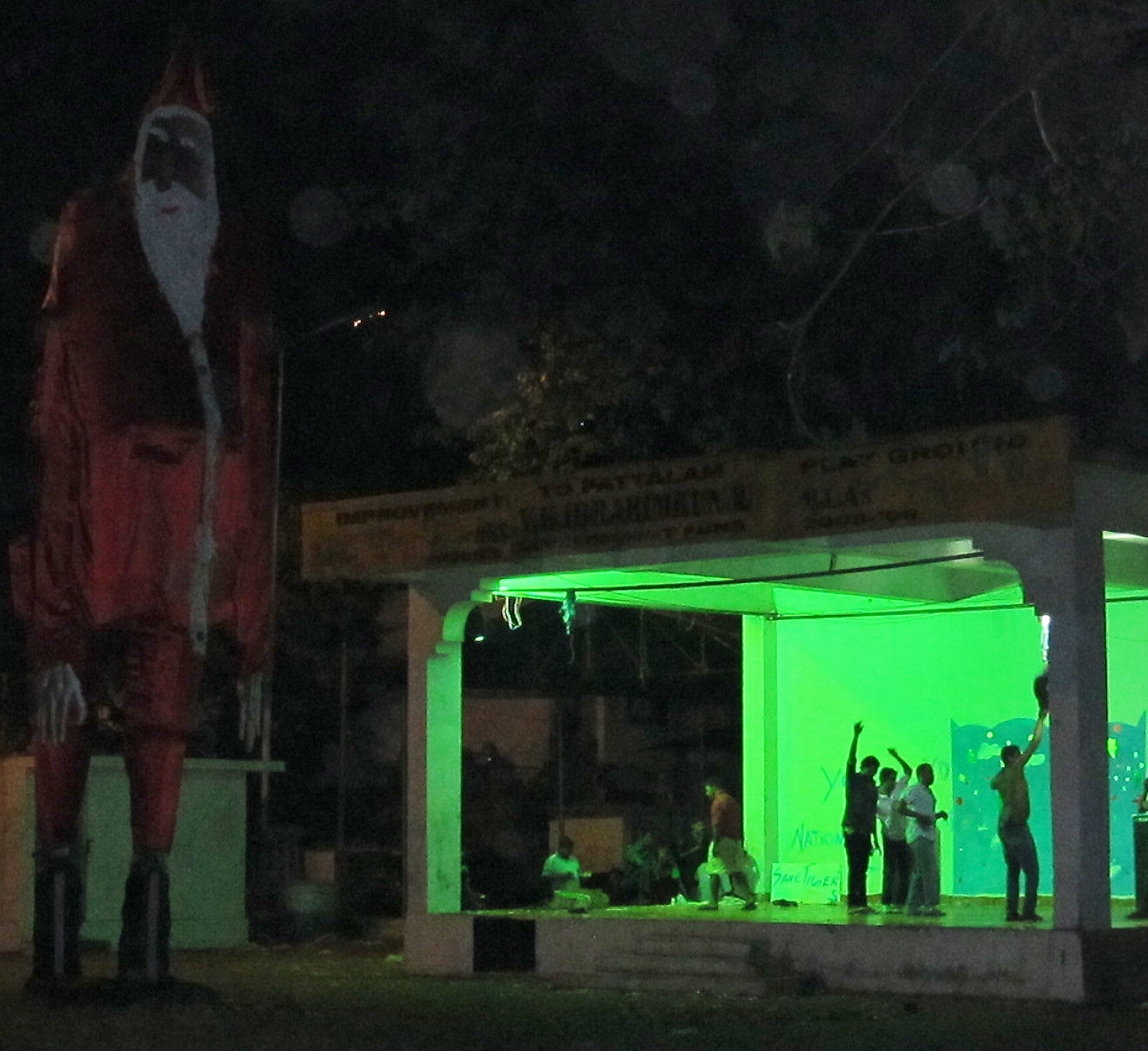
Well that was fun!  A night of new friends, fireworks, burning Santa’s and the occasional grope!  To which I returned death threats – which really freaks them out.  Which isn’t surprising given the nature of the police.  They would be pummelled for groping a tourist, but still they try.  We watched a man get set on by two police with sticks for not moving out of an area quickly enough for their liking.  Kochi, it seems, is a police state.  There were hundreds of them around over the past couple of days.  One couple we met got cordoned off from a crowd of a few thousand people so that the Indians weren’t too close to them.  I don’t know what they think is going to happen.  As a female you do get your arse pinched every now and again, but that is maybe one in every hundred people, and for the most part the Indians are excitable, friendly and just want to wish you a well.  No one has tried to take anything from us or have been violent towards us, and I am just as likely to get groped in a pub along Southampton high street.  And to be honest it is no wonder the men try it, men and women are so segregated here.  There is no physical contact between wives and husbands in public, there is certainly no sex before marriage, most marriages are arranged, and the women are taught not to look men in the eye, in fact the only women to look men in the eye are traditionally assumed to be prostitutes, who also smile as well.  So essentially all white women appear to be prostitutes to Indian men, because we look them in the eye and smile.  There are no frames of reference for men to go on, as the women they have sex with are either their wives or prostitutes.  There is no casual dating, or taking the time to figure out who you are and what it is you want from a partner, you just get married, by the age of 18 for a girl and 21 for a boy, usually to someone who your parents have chosen.  These attitudes are slowly changing, but when it comes to interactions between Indian men and Western women there are many cultural differences that mean that a lot of behaviours are misconstrued.  And oh my life do the Indian men sulk when a white girl spurns their advances, life is nothing without a healthy dose of melodrama out here.  And they seem to have a few problems understanding that white girls can make their own choices, and decisions, and don’t need a man to tell them what to do.  Luckily I have been only an observer to these antics, as they have a great deal of respect for the fact that I am with a man, even though he isn’t my husband.  On the flip side of this the Indian men are fiercely protective of the women and incredibly proud of where they come from.  They have kindly offered to stab anyone who gropes me, and when people say crude things in Malayalam about the white girls in their presence, if the antagonist sticks around too long, will find their mouths filled with another’s fist.  They say that even if we don’t mind, and people can say whatever, they feel that it is shame on them that their fellow countryman can be so offensive and see it as just as much an insult on themselves as us.

Anyhow New Years Eve.  We found some cute animals, got better aquainted with new friends, got groped in the crowds, watched Santa burn, were awed by fireworks, watched the police set upon a young man, went back to our second home, partied with some teenagers in a bus shelter, and for New Years day, went to watch the Kochi carnival, saw a LOT of men in drag, danced along with the music trucks, found a huge tree completely decked in fairy light, then wandered home for a well deserved rest.  I guess the photos will show better than my words, so here you are:



Friday, 9 December 2011

Kochi


More specifically Fort Kochi.  Kochi, an ancient port town, encompasses quite a diverse spread of towns and cities sprawling for miles across islands and peninsulas, within that there is Fort Kochi and Mattancherry.  Initially, when arriving in the quaint streets, the old Portuguese houses bowing out onto the quiet roads, immaculately presented offering arts, crafts, pots of tea and homestays, I felt a little irritated by the contrived nature of it all.  It is clean, quiet, pretty, and extremely un-Indian, so un-indian in fact that the only Indians that can be seen are the ones ferrying Whities around in their blinged up rickshaws, and behind shop counters.  I haven’t seen such a high ratio Westerners to Indians since I left the UK, even in Goa, there were as many Indians as there were Whites.  I could be in Portugal.  This is a destination for a two week, chilled out, holiday from work.  A place to kick back and relax, take in the heat, a bit of colonial history, and peruse endless arts and crafts shops sifting through little bits of Indian history, rounding the day off with a freshly scented cup of green mango tea and a slice of chocolate cake.  Along the sea front (which, with its dockland horizon, reminds me a little of a sweaty Southampton) there are timber framed Chinese fishing nets that bow gracefully into the sea to capture fish and seafood.  When the sun goes down, their silhouettes jut benignly from the shoreline in front of a sinking pink sphere.  Walking around the streets, into the richer neighbourhoods, there is a feeling of space and peace.  There are lots of green spaces and parks, with huge hairy trees and banyan trees lining the roadsides.  The colours are greens and yellows.  The horns are silenced.  The people move slower, and smile more.  And as contrived it initially appears, I would recommend this place for a two week holiday without any hesitation. 


On walking around a little outside the main tourist streets, the real feel of the place becomes apparent.  It is a little moment of calm in this vast frenetic country.  The tourist streets only take up a small area, and exploring beyond them the roads weave into little centres of commerce where spices, plastics, cooking pots, and many other wares are traded in bulk through secretive looking doors, Arabic in their design.  A stroll through the outskirts of Fort Kochi, shows the huge influence the traders of past eras have had on the area.  Its architecture is truly multicultural, with buildings boasting Chinese style roofs, atop colonial walls, to be entered through solid looking Persian doors, built next door to synagogues.  These streets make history present, the past is crystallised in the day to day trading.  Even in the more modern streets, there are less cars, less people, less bustle and less noise.  The old sits happily with the new, rather than being obscured by it as it seems to be in the other places we have visited (aside from Panaji).  All the buildings are low rise, so the sun streams onto the streets unhindered making the place seem bright and lively.  And the white people disappear.  It is incredible, one only has to walk 500m away from the few roads that have been put on show for the tourists and they completely disappear.  I wonder if there is a large invisible Chinese fishing net just over these roads that hold all the whites in one place, and it is only a few stray wigglers that manage to free themselves to go and look around the place where the Indians live.  And we like where the Indians live, hence we have decided to stay for a while.  I have even bought myself some Indian clothes, which are currently at the tailors being assembled.  And no, it is not a sari.  All the women in India, apart from in the really big cities, wear the same style clothes, either the sari, or a tunic, trousers and scarf combination (which I have opted for).  The lack of styling variety sounds a little dull, but the immense array of colours and patterns, mean that no two women are dressed the same and their fashion means that wherever there are women, the place is vibrant and sparkly.


We have found an apartment to rent on the outskirts of Fort Kochi, just far enough away from all the tourism to not even know it is there if we like.  It has two bedrooms, three bathrooms, a kitchen, living area, balcony and roof terrace.  Amazing!  So anyone who wants to come and visit, we have somewhere for you to stay.  We are moving in this weekend, and are employing a rickshaw driver, Edwin, to show us where we can buy good local produce to cook for ourselves and some popular local restaurants.  That is the only really bad thing about the tourist places here, the food is terrible, really terrible.  We have had to search really hard to find something good, and hopefully our local guide will be able to help us find where the Indians hang out.

Another wonderful thing about staying here is its location (another reason for you to come and stay with us!).  We are no longer than 4 hours away from some beautiful places.  There are the hill stations, wildlife sanctuaries, waterfalls, beaches and the backwaters, all just a few hours away to go and explore.  I have already taken a bus to the backwaters, which, a newly made friend described very aptly as a ‘hot Norfolk Broads’.  It is a series of tranquil waterways fringed by stumpy palm trees and the surfaces laced with beautiful, but suffocating African water lilies.  There is a constant stream of large wicker clad houseboats cruising along with chunky air conditioning units and generators hanging off their rear side, and little canoes with a crouched down man meditatively lapping the water either side with his paddle, propelling himself serenely.  Some of the waterways have been artificially manipulated to incorporate paddy fields, and there are little muddy islands accommodating a few homes, the owners washing themselves in their “outer-underwear” in their natural bathtub.  It is one of those places so beautiful that the rush of people to go and see it has taken away its essence a little.  We are slowly inching into the tourist season now, and already the waterways are busy with traffic, give it a couple of weeks and I think it will be gridlocked (would that be waterlogged?).  


All in all, Kerala seems to be a pretty relaxed place, with a pace of life that Alex and I can keep up with.  I am looking forward to the next month here and want to start absorbing more of the way of life, maybe learn a little Malayalam, enjoy the markets, and make some local friends.  I am hoping that things go well enough that we want to stay for 2-3 months……so all the more reason for you to come and stay, we can be your local guides! 

p.s. all the cows seem to have been replaced with goats…?

Tuesday, 29 November 2011

Ooty


This is an old hill station favoured by the homesick wives of the British.  When the heat and humidity of India became too much for these dispossessed delicates the hills beckoned.  The climate and vistas are surprisingly reminiscent of home, there are meadows in which horses roam freely, and plenty of firs and pine tree woods that dominate the lake strewn hills. There is also a summer palace for the Maharaja of Mysore, which was built by the Brits for the Indian King (although it seems he was a king in name only, and it was the British who controlled his purse strings).  Looking at the pictures running along the walls of its wooden grandeur, it appears to have served more as a place for the Brits to hang out and go on a jolly good elephant hunt.  There are many pictures of boastful, pigeon breasted simpletons sat astride a slayed elephant seemingly, very pleased with their might.

Ooty is about 2000m above sea level, which means that during the day it is quite warm, although tolerable to wear jeans, but at almost 4 pm precisely, the temperature plummets, sometimes close to 0.  The main town isn’t much to write about, it is comparatively small, possibly about the size of Southampton centre, and it is as busy and noisy as any other growing Indian town.  There, as everywhere else we have been, are remnants of the old colonial era slowly decaying behind a façade of bland, simple, modern structures, built for function rather than atmosphere.  There are the rickshaws, beggars, dirt, cows and plastic that can be found anywhere else in any India town.  It is the surrounds that make Ooty so spectacular, and also popular with wealthy Indian tourists (there is a surprising lack of westerners about).  


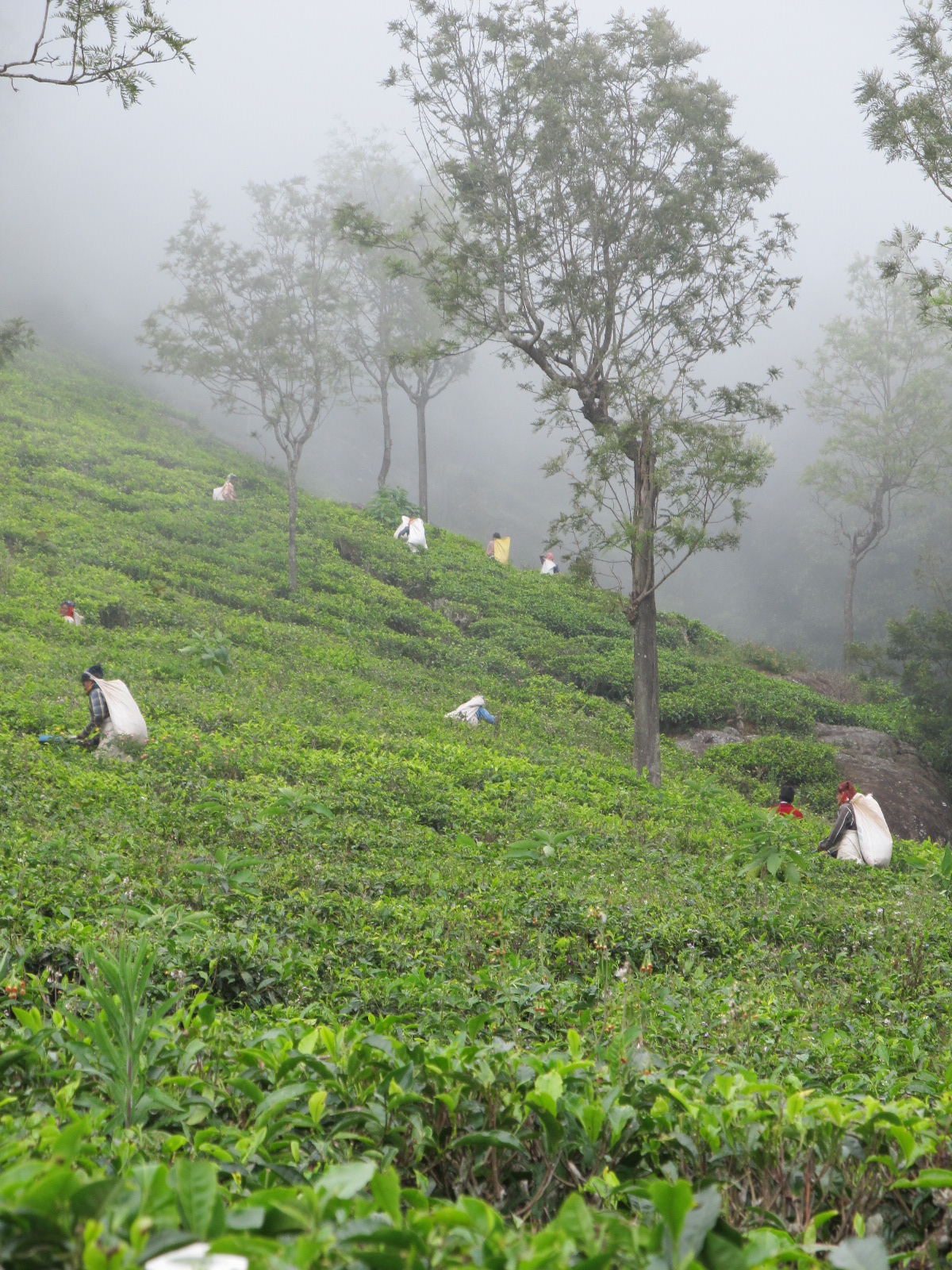
We are staying near the boat house which is on a manmade lake from the mid 1800’s, which is just out of town.  Surrounding it are tall fir trees that stretch far back over distant hills which sit wrapped in wispy clouds.  Outside of the town, there is a constant undulating green of tea plantations and tall trees that ripple across the landscape as the hills disappear skyward.  But, travelling higher into the hills, there can be seen sharp reliefs as some of the precipices fall dramatically away into the green below.  The tea plantations are vast, neat little clumps of bushes, divided by walkways for the tea pickers to reach the leaves, repeated over and over across the steep hills.  In the walkways the bobbing heads of women, plucking leaves and tossing them into large sacks on their backs, can be seen methodically meandering.  

We have been in Ooty for over a week, and spent a few days just looking at the beautiful view of the lake from our room and enjoying a bit of peace and quiet.  The days were languid and warm, with a temperate sun, the gentle sway of the trees rustled and the wind skipped a cool breeze across us.  We went for a walk in the woods, and just as I was commenting that I felt we could have been in Alice Holt woods, just down the road from where we lived in Alton, when I came face to face with a couple of muscle clad beasts, which turned out to be bison.  They were huge!  Just stood amongst the trees munching away, until we stumbled across them.  We weren’t sure what to do, are bison aggressive?  Will they charge if bothered?  Do they just freak like cows when approached?  These were not questions that we really wanted to find answers to, and they seemed pretty jumpy, so we waited, for ages, until they wandered off and we could carry on.  However, by the end of the walk, we’d seen so many of these beasts that we became quite nonchalant towards them.
 
The only other thing we did in Ooty was take a scooter out to look at the Nilgiri’s, the name of the hill range Ooty is in.  For 4 lovely days we had beautiful weather, the day we actually decided to get off our lazy bums and do something, the cloud descended.  All we saw of the breath taking views were breath freezing clouds.  Every now and again one would thin out and we got a tease through a misty veil of the wonderful vistas we could have been delighted by, but mostly it was a few trees disappearing into whiteness.  We also had a trek booked, but this was rained off, and we were rained in for 3/4 days.  Over two of them there was a rainfall of 13 cm, 14 people died and five huge fir trees fell in the road we were staying on taking out the electricity for a few days in the entire town (apart from Domino’s who had a generator).  Fortunately we were with a few other unfortunates who were also rained in so we all got drunk on local brandy and played monopoly.  

We have now finally left Ooty after a rather lethargic week and a half and are headed to Kerala (we hope to find somewhere to stay for a bit there, but it may be too expensive due to a large degree of tourism).  On the way we have stopped off at a place in Coimbatore, the Manchester of India, apparently, but it is not. It is much busier, noisier and grimier.  However, Alex and Rob (one part of the other couple we left Ooty with) have been approached to star in an Indian film.  Alex doesn’t seem so keen, so I am about to persuade him to do it………keep your eyes peeled for the new Tom Booze!!!  (We went, although Alex wasn’t in the film, another guy we are travelling with was.  I got really involved, it was a great fun, if not very long night.)


(I should also write about Hotel Darshan, or Hotel Headfuck as we have more aptly named it, with the oppressively friendly staff, and the fantasist mason that hobbled around it, who I suspect was one of those closet alcoholics, but it was a bit too weird.)

Sunday, 27 November 2011

Mysore


This place smells amazing.  It is quite a large centre for Ayurvedic medicine and yoga.  Almost every five paces an oil seller daubs the tourist in the sweet scent of flowers, fruits and trees.  At the moment I smell of 3 types of jasmine, lotus, sandalwood, jacaranda, water lily and orange.  As does Alex.  We smell of a fresh spring in a flower filled field, my nose is very happy.  I wonder if it is the smells that are making me soften towards Mysore.  At first arrival, I didn’t feel much for the place.  It is a small city, the main centre being about 4 km across, made up of narrow winding streets barely wide enough for two rickshaws to pass, flanked by 3 story buildings, some built over a 100 years ago, and others in the past year, side by side.  The character of the old buildings, hidden behind years of grime and the modern ones lacking anything unique, don’t lend much of an atmosphere to the city.  There are the ubiquitous horns, the streets filled with motorbikes, rickshaws, people and food sellers, all vying for the same space.  It is very easy to get disorientated and although knowing the destination is close, it is usual to spend many frustrated moments trying to figure out how to get to it.  However, since being dowsed in calming floral scents I am warming to the bustle of the place, and I haven’t dropped my smile once.


There are many more beggars in Mysore than we have encountered elsewhere so far.  Cripples strain themselves to hobble over to beg, and urchins tug on clothes desperate for attentions.  I have seen some of the most disturbing consequences of disease that have befallen the people that lay prostrate on the streets, withered hands outstretched, beseeching eyes where the light of life has long been extinguished.  Alex and I have a begging fund which all our coins go into, and I distribute a couple of rupees to each that asks.  I have been ignoring the children who pull at my arm, which is painful to do, as I understand they are usually begging for a gang master, or parents that have little respect for their offspring.  However today I had some banana’s we had bought as a snack, and some children ran up to us, as usual, and asked for money, instead I gave them a banana each, which seemed to make them much happier than any money would have done.  Afterwards a man approached me and told me I would have good karma for my actions.  He said if I had given them money they would have had to take it home to their father who would use it to buy drink, but by giving them food they benefitted and it was a much better thing to do.  So I have now resolved to make sure I have some fruit or biscuits as well as the begging fund each time I go out.  I feel much better knowing that there is something I can offer these poor, dirty, guttersnipes.  

On a lighter note we have been finding some of the most delicious food.  There is a restaurant close to where we are staying, constantly crammed with local people, that serves the most incredible thalis.  On sitting down on one of the narrow chairs, a large banana leaf is laid out on the table, and a cup next to it.  There are a few waiters of sorts that wonder around the small restaurant, one with a large pot of rice, others with smaller pots of curry, or little ramekins of soupy type curries and poppadums .  Each approach the table and dollop a load of it onto the banana leaf, so that once their circuit has been completed there is a colourful assortment of the most fragrant and splendidly spicy curries, beautifully arranged on the leaf.  As soon as one of the curries or rice is run down, a waiter appears and spoons a little more onto the leaf.  It is an all you can eat thali fest, all for about 80p.  Amazing.  And there is no cutlery, so all feeding is done using the right hand.  (It is difficult not to engage the left hand in the process of eating, but it would put the other diners off their food somewhat seeing someone eat with what they use in place of toilet paper.)  I like eating with my hands, pulling the curries into the rice and gently massaging it with the fingers to form neat little parcels to pop into the mouth.  Feeling the texture of the food before eating it gives the meal another dimension of sensory experience.  

I have also had what I thought was my first real experience of racism (it turned out to be an inverted type of racism, I will explain later).  We have been eating in quite a few local places that appear to be very popular.  Often these places are so busy people queue for a seat.  Most of the tables seat four people and strangers sit happily alongside each other.  Except with us.  We are avoided, people would rather wait than share a table with us, they won’t even make eye contact, they just stand by the door waiting for other seats to become free.  The first time it happened I didn’t think too much of it, however after the third or fourth time it started to upset me.  The waiters seem happy to serve us, many of the Indians want to take our photo, and people stop us all the time to talk to us, so it felt strange that they wouldn’t want to eat with us.  Maybe, I tried to reason, they thought we would be unpleasant eaters, or more cynically, there was nothing to be gained financially by sitting with us, so we were seen as people to avoid.  I tried to ask a couple of people why this was, but my question was evaded.  It was awful to think we were not respected as people, but only as money boxes to be shaken when a few coins are required.  The morning that I pondered this experience of being viewed as a pariah had quite a profound effect on my confidence.  I began to feel uncomfortable around people as they asked for my photo or tried to talk to me, unsure as to how people were viewing me.  Was I seen as a whore because I am an unmarried woman, yet have a boyfriend?  Eventually we found a very good English speaking Indian in a shop who could explain to us why we were shunned in restaurants.  According to him there is a view amongst Indians that western tourists think they are superior so will not want Indians sitting next to them, and they are also embarrassed that they do not speak English.  These are the reasons we are left alone in local restaurants.  So now, we try and engage the people around us, and will start asking them to sit with us if we see they are waiting.  Even though the attitudes of the people turned out to be more self-deprecating than irrationally offensive, it was interesting to experience a small inkling of how those that are treated poorly due to their skin colour.  It is certainly unpleasant and I can see how self-confidence is seriously undermined by racism. 

Other than the smells, and the lovely thali, Mysore boasts a huge palace that still belongs to the Maharajan family that once ruled here from ~500 years ago.  The original palace was made of wood, and although it survived hundreds of years without accident, a fire broke out in 1897 that destroyed it totally.  The princess that lived there commissioned another palace to be built, this time out of granite.  A British architect was chosen for the job, and pulled influences from Islamic, Hindi and Victorian architecture to build one seriously opulent palace, which in places literally takes the breath away.  The craftsmanship that has gone into this place is outstanding, the ivory inlaid doors and beaten silver work make even the observers eyes sore when looking at the minutiae of detail that has gone into decorating them.  Unfortunately we weren’t allowed to take a camera into the palace, but the pictures from the outside hopefully give some idea of the scale, from the grandness in size, to the intricacy of detail.   


There is also a hill with pretty spectacular views of the city, a large, ugly, gothic style cathedral, lots of incense stick makers, a busy colourful market and silk pashmina shops. 

Alex has been making use of his time here, and has begun exploring potential new professions. 

Sunday, 13 November 2011

Hampi


This place is almost unbelievable.  The boldness of its beauty is just breathtaking.  The heart feels overwhelmed.  Hampi , as it is now, is just a small village, there is a bazaar with narrow streets that feel cluttered and erratic, lined with cows and small shops selling jewellery, clothes and general commodities, a few guest houses and very little happening, but there is a sense of serenity here, and calmness that rests on the soul upon arrival.The place feels quite surreal, and I finally feel I am getting closer to the Indian experience.  From the motorised buzzing of the yellow and black rickshaws that chase the tourists around, to the magic baba’s with painted faces and orange robes, plucking golden trinkets from thin air, coughing up huge stones and the village elephant decorated with colourful painted patterns.  All the senses are tantalised.  There are the sounds of a procession, trumpets, flutes and drums as they meander around the village announcing the marriage of a young couple, the music lasting three days (there have also been the sounds of their arguments when the alcohol has got too much and the women and men screech ‘you bitch’ at each other in their local language from the roof tops).  There are smells of sandalwood and jasmine as thick whorls of joss stick smoke twist from the houses and restaurants into the street.  The feel of children as they run up to touch the skin of a strange white giant.  The taste of real Indian cooking, not food adjusted for the sensitivities of the westerner, but spices that set the lips tingling like hot coals, and chilli that builds an inferno in the mouth long after the meal is over.  And there is the visuals, oh, my weary, happy eyes.The world here seems vibrant and fantastically peculiar.


We are staying in a brightly (a bit too brightly) coloured guest house by the river next to the bazaar.   In the mornings the villagers head down to the river to wash themselves and their clothes.  The river is accessed by a grand set of ancient steps that boast the importance of water, and the river itself has to be one of the most sightly rivers I have seen.  The width is only around 20 metres, but it curves subtly with the calmly flowing water, easing itself around large boulders and gently wending into the distance.  And it is the boulders that give Hampi its beauty.  As far as the eye can see there are jumbled hills covered in huge rocks, many as big as houses, interspersed with palms, where they found gaps in between the big, big stones.  The rocks are piled high on top of one another, some seeming to defy gravity, others, somehow weathered so the underside has been eroded and the boulder rests precariously on a miniscule, natural, plinth.  The colours of them are warm too.  Shades of orange ranging from those with a pinkish hue through to hints of brown that meld across the cool grey of the rocks.I feel my words to the natural wonder of this place are no justice.  Sat atop one these boulder strewn hills, looking at the phenomenal landscape, no further explanation is needed to understand why the people of the 13-16th century chose this place to build their monuments to their gods.

And what monuments they are.  As visually impressive as the landscape they are set into.  From our guest house it is possible to see the temple to Shiva, a colossal, yet profoundly intricate structure set at the bottom of one of the hills.  Its unashamed conspicuousness towering skyward tells of man’s wish to honour the integrity of the surrounding landscape.  The reliefs carved from the stones making up the temple show a more liberal and licentious attitude that the ancient Indians had when compared to the prudishness that binds the people in more modern times.   The monkeys that scamper around it with seemingly mischievous intent appear more in touch with the essence of the place than the people now living around it.

There are many other temples and small buildings around Hampi, there is a circuit of around 12 km in which they are all contained.  There are many much smaller monuments that, although built with grandeur and flair, regardless of their scale, all of them seem to fit harmoniously into the environment.  They are sat upon the boulders, around them and somehow with them.  Maybe it is because the Hindu’s incorporate many elements of nature within their belief system that they were able to build something so in-tune with the scenery it is set in.  There are temples dedicated to Ganesh the elephant headed god, Hanuman, the monkey-man god, and to the many incarnations of Shiva, Vishnu and Krishna.  There are also Islamic mahal’s and mosques, grand stables to house elephants and bazaar upon bazaar, where simple columned structures are lined into the distance from the entrance to the temples.  In the Hampi bazaar these old columns are still being used.  People have filled in the gaps and turned them into houses and shops.  This absorption of the ancient into present day shows continuity, there seems to be something quite honest about using these buildings for practical purposes rather than just to admire. 

The most impressive of the temples is the Vittal, more for the size of the complex than the craftsmanship, which is as intricate and as splendid there as the other large temples in the area.  On walking into the entrance the visitor is greeted by a huge stone chariot, which apparently functioned as a moving vehicle at one point, which on seeing the density of stone sat upon the beautifully carved wheels seems impossible, but India seems to be the place where the impossible can happen.  There are pillars and shrines, all carved with such delicacy and beauty it is, after a whole day of looking at these wonders, exhausting to the eye.  


We hired push-bikes for the day to explore the ancient complex which was the perfect way to see the sights.  It was a leisurely tour through the majesty of nature and man combined.  I have been here for three days now and still feel overwhelmed by the immensity of the place.  We have sat in the shade of decadent temples, and wondered at the precariousness of the huge rocks as we rode past them.  And the place, at the moment, is quiet too.  There is no bustle of people being shuffled around; some places, being devoid of anyone but us, which means we could sit and feel the place envelope us in its grandeur.

There is also one of the loveliest places to see the sunset I have ever been to.  There is a hill next to the Shiva temple near our guest house, which is littered with spectacular boulders and ancient monuments, at the top of which, is a large boulder jutting out over an edge.  Sitting at the end of this boulder and watching the sun set behind the irregular hills, the reds and purples spewing gloriously into the darkening clouds, and the silhouettes of bats over a metre in span passing with strong beats of their wings, is a treasure no money can buy.

Wednesday, 9 November 2011

Candolim and the North Goa Beaches


CANDOLIM

To say this was the Benidorm of Goa might be a trifle unfair, but then we arrived here a couple of days before the ‘season’ started.  Over the weekend the first tourist coaches arrived, clogging up the roads and depositing fat westerners, like plaque on an artery, onto its worn and broken pavements.  Where Palolem was geared up for independent travellers and back packers, this place is for the package holiday.  The long stretch of road running parallel to the beach is lined with large hotels that vary in their degree of palatability.  There is a supermarket with queues that wind impatiently through the aisles, bars with big screens to show two football matches simultaneously, soon to be packed with Bacardi Breezer swilling apes, restaurants boasting their selection of fried breakfasts, roast dinners, steaks, chicken tikka masalas, and karaoke, and the sandy run up to the beach, litter strewn with plastic of differing shapes and sizes.  And then there is the beach itself, the plastic waste blended with the large gritty sand, that is lose and an effort to walk upon, scratching between the toes.  Sunbed upon sunbed lined row upon row, as far as the sun dazzled eye can see, all looking out onto the sea.  The sea with its pounding waves and fierce currents.  The sea with all of Goa’s cargo ships sat waiting to be let into port, the silhouettes of those furthest away looking like little grey monopoly boats.

There is also the sex tourism, which although it existed in Palolem, the women there were slim, attractive and the same age as the men they chose to indulge in a little Indian romance with.  Here however, it is not uncommon to see a handsome young Indian, hand in hand with some barrel shaped woman, with neon blonde hair, coarse from years of bleach, and a shiny, pink face, 20, 30 years his senior.  I must admit in Palolem it didn’t dawn on me that the pretty young white women seen with equally pretty young brown men was to do westerners and Indians until I spoke with one of the men that worked at the beach huts we were staying in.  He was particularly distressed one day as he had seen the girl he had been chasing with some ‘dirty smelly Indian that didn’t wash’.  He was clean he insisted and couldn’t understand his rivals appeal.  I learnt through a few other barmen that to come and work on the beaches during the tourist season was a no brainer for young single Indian men.  I naively thought that it must be the money that drew them from all parts in India to work, but it turns out that the lure of scantily clad pale flesh, looking to offer itself to smooth talking lothario’s is a fairly attractive pull also.  The women offer them drinks, meals out and finally their beds for a week or so, and in return they get a real taste of India.  One thing I do find curious though, is why aren’t all the Indian men in Palolem?  Without wishing to sound fatist/ageist/not sure what, but something ‘-ist’ I expect, but the ascetics are far more pleasing around those parts.  I suppose the older they are, the more likely they are to have a bit of cash, or is that being too cynical?

I am being a bit mean about Candolim.  We have been here for almost a week, and we are having a fine time.  We have a lovely room, off the main roads, with a large balcony that looks out onto a small garden with palm trees and greenery.  I have seen woodpeckers, eagles, a mongoose and butterflies as big as my hand visit our little oasis regularly, and the woman who owns the place is wonderful (she is also obsessively clean so no unwelcome beasties, my man sleeps soundly at last).  The beach road is nice enough, with yet more fairy lights, less traffic, and friendly shopkeepers and waiters, all of whom remember your name and say a cheery hello as you walk past (apart from the scarily serious Faroque who works the shop closest to us and asks us with great intensity what we are doing every time we pass him).  And if you turn right on the beach it possible to leave the industrial vistas behind and inch a little closer to paradise
.  

We have taken a couple of days out of Candolim, once to explore the northern beaches, and the other to drive around a little and explore the villages and countryside.  Driving around the countryside is wonderful.  There is something really liberating cruising along quiet back roads, the greens bursting from the roadside and across the fields, the russet earth skilfully blended by mother nature to provide a colourful contrast, the dust lightly flicking the face, and the warm air rushing past and through the hair.  It is truly a simple, but exhilarating pleasure.


ANJUNA

The party beach.  Where Goa goes and goes and goes.  Apparently.  Just not right now.  

There is a large flea market that is held there every Wednesday, that was started by the hippies many years ago.  It reminds me of the North African souks of Morocco.  Stand upon stand of vendors selling similar wares to their neighbouring stalls, lined up along winding roads, flanking either side of it.  As one travels past the make shift shacks containing bright clothes, smooth silky looking wood, cheap trinkets and aromatic spices, there are the calls of the vendors desperate for the attention of the hapless tourist, ‘Cheap, cheap.’, ‘Good quality, come look, just looking.’, and ‘Cheaper than Adsa!’.  The sellers are savvy and outrageous with their starting bids.  I asked about an old coin that was with many others in a cardboard box, the starting bid was 650 rupees (almost £10), I smiled and told him that I would pay about 70 rupees, and he immediately reduced his price to 250 rupees.  (I still didn’t buy it.)  But it just shows how unbelievably ruthless they are at prizing money from the tourists pocket.  


There are also the ear ‘cleaners’ too.  Pesky little parasites, who accost you as you walk past by grabbing your ear and launching towards it with a long spike and a dirty cotton bud.  I watched it happen to someone, who being a little more tolerant to being poked and prodded around, let this man scrape around in the insides of his ear as the man pulled vast swathes of orangey looking gunk from it, before finally producing a small stone.  They then pass a card to the stunned and violated victim stating that if they extract stones from the ears they need to be paid a vast sum of money, around £20.  This is all a con of course, and they use a slight of hand to produce the revolting looking ‘wax’ and little stone, and the dumbfounded dupe is left with a lot less money, and a dirtier ear for the pleasure.

After the market we walked back up along the beach and were greeted by some upbeat and inviting bass lines from one of the bars.  We went inside for a couple of beers, it was early so there were only a few people around.  We were told that things would liven up around 9, so we decided to stay around and see what the party scene at Anjuna was like, considering its reputation as the 24 hour, full power party paradise.  We hung around, a few drunk Russians turned up flailing their burly bulks around, and then the music stopped, at 11.30.  That was the party.  I understand that when the tourist season really gets going, around Dec, Jan, Feb and Mar, things go on a little longer, and the bars get rammed.  I am just glad we didn’t come to Goa looking for a party; we would have peaked far too soon and missed the main action.

CALANGUTE

Hell on earth.  Hot, rammed, noisy, dirty, an assault on every sense.  The sea is packed with paragliders and jet skis bouncing around off the waves and swimmers heads.  Don’t ever go there.


The rest of the beaches are a mixture of picturesque calm, silky sand stretched along the shoreline or busy, bustling throngs of people, looking for the next bar/sunbed.

We leave Goa today, to go and explore India.  xxx

Sunday, 6 November 2011

The News

Petrol shortages:
I was shocked the first time we hired a scooter, and found that 2 litres of fuel was almost as much as the hire of the machine for the day.  We were told by the scooter lender that for one litre it would 80 rupees, just over a pound.  Thinking we would be naïve and foolish to pay such ridiculous prices I told the vendor that the price was crazy and that he shouldn’t try and take advantage of us, he insisted he wasn’t.  It turns out he wasn’t.   There is a real fuel crisis in Goa at the moment.  People are queuing for hours on end to fill up, and many of the petrol stations are empty.  Over the past couple of days there has been panic buying and it is being sold by unscrupulous traders for 150 rupees a litre at the moment, that is £2 per litre, £2!!!  I honestly don’t know how people afford to run their vehicles here. 

Above average temperatures for November.  No sign of any winter chill, says the paper, these are summer temperatures.

Illegal Mining:
This seems to be a really big problem in Goa.  There is estimated to be around 40 illegal mines operating in Goa at the moment.  They are mining for iron ore.  And there is big money to be made out of mining, it is thought that 25 000 crore has been made over the past couple of years (a crore is 10 million rupees), and the government seem to being having a problem on stopping illegally operating mines.  I am not sure why this is as they must be pretty obvious, I would imagine that corruption makes a fair contribution.  The illegal mining leads to the dumping of a lot of toxic waste products that pollute land and cost much to clear up and these mines are destroying vast swathes of protected forests.  Even the legal mines are big problems for local farmers, taking fresh water away from the land and land as well.

Not enough coconut climbers to harvest coconuts in Kerala.

Water Shortages:
There is already a problem with water conservation.  With the ever developing tourism, and influx of rich Indians who have made their money abroad are building massive properties in the Indian paradise, it is thought that there will be severe water shortages for the state in the next 10-20 years.

Two men stabbed in Mumbai for defending a female friend who was being harassed in a paan shop.

Radiography Conference:
Organised to teach radiographers in the dangers of radiation would you believe.  Apparently there are no education criteria to be met to be a radiographer in Goa.

The beheaded bodies of children found in Lucknow believed to be human sacrifices.

China:
Concerns about Chinas supply of nuclear warhead, 4 of which are apparently aimed at India.  A challenge of an Indian warship in the South China Sea by the Chinese.  And a map released by a private Chinese company that shows part of India to actually belong to China.

Inequalities between the burgeoning middle classes and the poor, still in many states, damned by the supposedly outlawed caste system.

Criminal Politians:
The government is proposing new reforms concerning who should be allowed run as candidates in elections.  As it stands at the moment, only people convicted in a trial court and sentenced for more than 2 years in prison are not allowed to run for government.  So a person on trial for multiple murder charges is able to contest elections.  And if a current MP is convicted of an offense and sentenced to more than 2 years in prison, they can still continue to represent the people.

The continuing efforts of ‘Team Anna’ to expose and eradicate corruption within the upper echelons of government.

Security to prevent terrorism:
The amount of paper work that is required by hoteliers/guest house owners and internet cafes to track travellers is extreme.  The Indian government seems particularly paranoid, and every time we move to a new play to stay, there are 3 forms that need filling in detailing all our passport and visa details, where we’ve come from, where we plan to go, when we arrived and our address and contact numbers in the UK.  The guest house owners then have to take this information along with 5 photocopies of out passports to the police station within 24 hours of our arrival.  Then there are the internet cafes that are required by law to take down our names, addresses in India and England and occasionally our passport details; however no one has demanded that yet.  They also have to keep all their internet browsing history and log books for 6 months.

And finally, Katie Price, aka Jordan, likes being single.  Yes, that really has been reported in the Times of India.

Wednesday, 2 November 2011

Panaji and Old Goa

PANAJI (PANJIM)
We are currently sat in an exquisitely restored typically Goan house waiting for some dinner.  The Portuguese influence pervades all the buildings here, and the inside of the restaurant is coloured in bright terracotta orange and lemon paint, with wonderfully crafted dark wood furniture with intricate flower designs, including the heavy door and a cool, grey, veined marble floor.  The walls are adorned with pictures distinctly European in their subject matter, as are the ornaments and statuettes in the alcoves within the walls.  The atmosphere is intimate, and the friendly waiters are clearly enjoying the music that is being played loudly – if my ears serve me correctly I believe it is the Venga Boys, but I could be wrong.  I understand Vasco De Gama conquered the beaches of Goa in the 16th century enthusiastically singing ‘I wanna have sex on the beach, come on everybody!’ and thus brought Euro-pop charm to India.
After almost a couple of weeks happily entrenched in Palolem, we finally got the gumption to say goodbye to the Goan beach holiday.  We could feel the next 6 months slipping away into a pleasant sandy coma with the days coming and going as gently as the tide.  But, it was getting much busier, and we were getting upset that ‘our’ space in the sea for frolicking was being increasingly encroached by the ever growing number of tourists; many of whom were Indian, and would ask to pose with myself and Alex while friends took picture of us.  It was like getting hounded by the paparazzi.  Our departure was made even timelier by the guest we had on our last night.  At about 1 am Alex was tickled into arousal by an amorous intruder, and he awoke to a cockroach whispering something about a ménage a trois into his ear from his pillow.  Alex was not impressed, as the torch clicked on the roach stared back at him with incredulous curiosity.  ‘What you don’t want me here?’  it seemed to ask, its little antenna wiggling around suggestively.  Alex chased him off the bed with a slipper only to find a number of his much larger mates having a party around my backpack.  They all legged it, apart from one unlucky beast, when they saw the slipper being swung towards them.  The rest of the night Alex took vigil to ensure our decency remained intact, and we were not sullied by the naughty little pests.  Every hour or so the violent twitching of a man determined to remain untouched by the filth of the roach, followed by the click click of the torch alerted me to the fact that my man was protecting us, if not letting me get any sleep while doing so.  (There is also the story of a thoughtful rat that left me the present of a little poo on my pillow, but I feel these incidents could become numerous over the next year to recount every one.  Hopefully Alex’s responses will become more accepting in nature as we continue our travels – the diary of neuroses is getting very full!)
But I have digressed.  Panjim; what a stunning city.  It is the capital of Goa and has been since the mid-19th century.  As I mentioned earlier the Portuguese character is absorbed into many of the buildings.  You see the beauty of the city flaking in its once startlingly coloured paint, now fading, peeling from the walls of the old buildings, contrasted with the freshness of the new houses, faithful to the old style of architecture.  The houses themselves are vibrant, even those in their age, crumbling into the narrow streets that weave through the town, reminiscent of a medieval Europe.  There are tall arched windows set into flat, smooth walls, and on the upper floors verandas with wrought iron, or stone balustrades stretch along the buildings.  Along the broken roads that snake lazily around the houses, there are vivacious greens from the weeds breaking up the tarmac, and even in the abandoned looking houses, mould blackened from the humidity, nature enlivens the exterior with beautiful greens and the occasional flower.  Bright, bright white churches, placed here and there around the lanes and roads seem to defy the process of time happening around them, standing as beacons around the fading glory of the city.
It appears to be quite a small, but wealthy city; we have spent a couple of days wandering around it now and have yet to stumble on any extremity of poverty, that is not to say there isn’t any, but it seems to be either better hidden, or at a lower level than other places I have been to.  We have found some incredibly opulent areas though, with great colonial style mansions, many faceted buildings standing strongly atop hills looking proudly across the town below.
We like it here; the environment is unthreatening and friendly, at night it is well lit, Diwali lanterns flutter gently in the warm night breezes and many coloured fairy lights adorn the houses.  During the day, as long as one stays amongst the back streets, it is atmospheric and the history seeps into to your pores, clogging you with nostalgias for times gone by (the main roads are busy and really noisy with the cheap car engines and endless horns).  I think I could stay here for a long time, it feels familiar and inviting; but we are moving onto another beach shortly to meet with friends coming for a two week holiday from England, not before we go and explore Old Goa though.  It is said to have rivalled Lisbon for culture in the 17th century.  I can’t wait…..


OLD GOA
Well it turns out I could have waited.  All that is left of Old Goa is a few large cathedrals that were built in the 17th century, each one a grander version of the preceding one.  It looks like the Portuguese had a cathedral off.  There was none of the atmosphere and feeling that oozes out of Panjim, apart from one small section of road.  There you could see the faded grandeur of what once existed; and if that one section of road was anything to go by it would have looked truly awesome.  However, despite its lack of vibe, it has been designated a world heritage site and there were tourists aplenty suffering the brutal midday sun to go and look at statuette after statuette of crudely executed, sad looking Saint Francis of Assisi. 
By the amount of times I was asked to be photographed I don’t think the Indians were that impressed by the pride of Indian Catholicism either.  I think I was the most photographed ‘attraction’, second only to a dead saint lying in a box that apparently never decomposed despite being dead for the past 5 centuries.  I am not sure what that says about me or the Indians.  I have resigned myself to this draw of fascination, and have started charging people 5 rupees to have their photo taken with me.  They find this a little bemusing, but I do insist they part with their change if they want to pose with me.I then pass on the 5 rupees to the next beggar I come across that asks me for money.  And this is not just young men who approach me, women, children and families all ask as well.  There are those that don’t ask too, some even go to the great lengths of orchestration in order to make it look like they are being photographed with me.  For example, and this happened a couple of times, people would pose just ahead of where I was going to be walking, their friends ready to take aim, and as I passed they got their shot.  Everywhere I looked I saw eyes quickly averted and cameras flashing.  It was amusing enough today, but I am not sure how patient I am going to be if this is a regular occurrence over the next year.
As for Alex, he’s pretty happy, he’s found Jesus.